The Compute Crisis: Why Structural Semiconductor Shortages Mean Bitcoin Becomes Infrastructure, Not Speculation
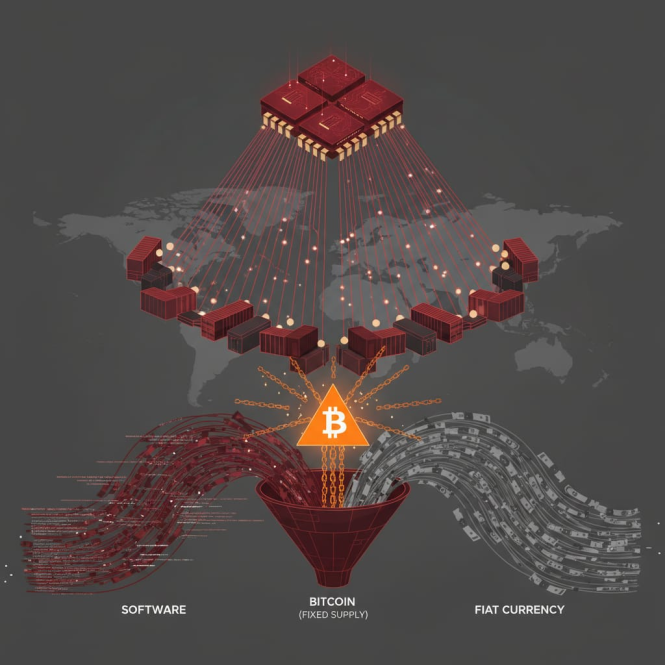
Reporting on Jordi Visser & Anthony Pompliano on AI inflation, supply-driven economics, and the death of the software cycle.
I watched a conversation between Jordi Visser and Anthony Pompliano that crystallizes something critical most investors still don't grasp: we've exited the software abundance cycle and entered the hardware scarcity regime. This isn't cyclical. It's structural. And it rewrites the entire investment playbook.
The conversation is deceptively simple on the surface — a discussion about chip shortages and inflation. But beneath it lies a complete regime change: the Federal Reserve's tools become impotent, traditional monetary policy breaks, and assets like Bitcoin transition from speculation to infrastructure play.
Let me unpack what they're actually saying, because the implications are profound.
The Core Insight: We're Out of CPUs
Visser opens with the blunt statement: "We are out of CPUs a year."
That's not a prediction. That's the current bottleneck.
Musk is quoted as needing "$5–13 trillion worth of semiconductors" to achieve his objectives. Let that land. Trillions. We have no infrastructure to manufacture chips at that scale. The foundries can't keep up. TSMC, Samsung, Intel combined cannot satisfy demand that's growing exponentially while they can only build capacity linearly.
This creates a fundamental shift. For the past 15 years, the story was deflation through software. Software scales infinitely. Marginal cost drops to zero. The business model is "build once, sell infinitely." Pricing power evaporates.
Hardware is the opposite. You cannot manufacture more semiconductors than you have fab capacity. You cannot exceed physical limits. And when demand exceeds supply structurally — not cyclically, but permanently due to AI acceleration outpacing infrastructure — scarcity becomes the dominant economic force.
Visser: "We have reached the physical limits of AI."
Not yet. But we're approaching them. And that's what matters.
Why Inflation Stays Above 4% — And Why the Fed Can't Fix It
This is the macroeconomic bombshell most analysts are missing.
For the past decade, inflation has been demand-driven. You could fight demand-driven inflation with rate hikes. Raise the Fed Funds rate, cool demand, prices fall. Classic monetary policy.
But supply-driven inflation is different. If semiconductors are scarce because we physically can't manufacture enough, raising interest rates doesn't create more foundries. It doesn't speed up fab construction. It doesn't unlock geopolitical supply chains. Rate hikes just crash demand and potentially break something else (the financial system, credit markets, asset valuations).
This is the policy trap. The Fed can't tighten enough to fight supply-driven inflation without causing systemic damage. So inflation stays structurally elevated — above 4%, persistent, and immune to traditional monetary tools.
Visser acknowledges this clearly: traditional business cycles are dead because monetary policy has "perfected the QE playbook." But that same perfection becomes a curse when inflation is supply-constrained. The Fed is locked into accommodation. They can't raise rates effectively. They can only manage optically.
This is why asset prices inflate by necessity. Not because of monetary policy choices, but because the alternative is economic collapse. If you can't control supply-driven inflation through rate hikes, you manage it through asset price inflation and currency debasement. The nominal value of physical assets (semiconductors, bitcoin, commodities) rises to match the expanding money supply.
Oracle Isn't a Software Company Anymore. It's a Compute Company.
This quote is the inflection point: "Oracle is not a software name anymore. Oracle is a compute name."
What does that mean?
It means the traditional tech categorization breaks down. Oracle historically was valued as a software company — high margins, software economics, infinite scaling, multiple compression as growth slows.
But in a compute-constrained world, Oracle is valuable because it has:
- Massive data centers
- Compute infrastructure
- GPU capacity
- The ability to provision AI workloads
Suddenly, Oracle's valuation is driven by compute scarcity, not software abundance. The correlation flips. Oracle benefits from high semiconductor prices, tight capacity constraints, and the desperation of enterprises needing GPUs at any cost.
This isn't just Oracle. It's every tech company with physical infrastructure. The old correlation structure breaks. Companies with compute assets become beneficiaries of scarcity. Companies selling software without physical backing become victims of cost pressure.
Bitcoin Decouples From Growth Assets
In a compute-scarce world where inflation stays structurally elevated, Bitcoin transitions from speculation to infrastructure.
Here's the mechanism:
In the old world: Bitcoin was a growth asset, correlated with tech stocks. When growth assets sold off, Bitcoin fell. When rates rose, growth assets underperformed, Bitcoin underperformed.
In the new world: Bitcoin is a hedge against persistent currency debasement. In a system where:
- Inflation can't be fought with rate hikes
- Money supply must expand continuously
- Asset prices must inflate to absorb the expanding money supply
Bitcoin, with its fixed supply of 21 million coins, becomes the only rational alternative to fiat currency exposure. It doesn't correlate with tech sentiment. It correlates with monetary necessity.
Visser notes that institutional adoption is accelerating. Morgan Stanley's ETF launched with $300+ million in first-week flows. Charles Schwab is now offering direct Bitcoin trading. This isn't speculation catching fire. This is institutions saying: "Given fiscal dominance and supply-driven inflation, we need a fixed-supply asset hedge."
Bitcoin miners become infrastructure operators, not speculators. Mining becomes a compute play — the ability to turn electrical power into hash rate and earn Bitcoin becomes valuable because Bitcoin is now the denominator asset for a scarce-compute economy.
Geopolitical Supply Chain Weaponization Becomes Permanent
The Iran strait incident isn't just about oil. It's a preview of permanent supply chain fragility.
In a world where semiconductors are the new oil, geopolitical control of supply chains is weaponized. China controls rare earths. Taiwan manufactures most advanced semiconductors. The Middle East controls energy for crypto mining. Russia has materials. Each chokepoint becomes a leverage point.
Visser: "What happened in the Straits of Hormuz has changed the world."
This creates a permanent risk premium on commodities and energy. You can't resolve this with monetary policy. You can't QE your way out of a Chinese export ban on rare earths. Commodity supply chains become national security issues.
The investment implication: commodity and energy exposure is no longer cyclical positioning. It's geopolitical insurance.
The Options Strategies: Reading the Conviction
Visser provides specific options strategies:
- Bitcoin bull call spreads via MSTR
- Semiconductor shortage puts on SMH
- Software disruption bear spreads on XLK
- Long INTC, long MSTR, short CRM, pair trades
This is important because options strategies reveal conviction. You don't construct a 5:1 risk-reward ratio on INTC unless you believe the thesis deeply. You don't short Salesforce with defined risk unless you're confident in disruption.
The strategies have 12–24 month time horizons. This isn't short-term trading. This is positioning for a regime that lasts years.
The Trade Ideas & Risk Management
The high-conviction trades are:
MSTR (MicroStrategy) — 4.1:1 risk-reward, 6–9 month timeframe. Bitcoin proxy with leverage to institutional adoption and miner benefits. Entry $1,800–$1,850, target $2,400.
INTC (Intel) — 5:1 risk-reward, 12–18 months. CPU shortage, pricing power, turnaround. Entry $45–48, target $65+.
Short CRM (Salesforce) — 3.1:1 risk-reward, 6–12 months. AI disruption, seat loss, abundance play vulnerable to compression.
XLB vs XLK pair trade — Materials outperform Technology as scarcity dominates. 2:1 risk-reward, 12–24 months.
Semiconductor miners (BITF, RIOT) — 5:1 risk-reward, 6–18 months. Miners become infrastructure operators as compute becomes the bottleneck.
What's notable: none of these are betting on things going better. They're all bets on structural constraints becoming permanent. INTC isn't going higher because Intel innovates. It's higher because chip shortages last 12+ months. CRM isn't shorted because Salesforce fails. It's shorted because the cost of AI tokens makes traditional seat pricing uneconomical.
The Risks They Acknowledge
To their credit, Visser and Pompliano outline real failure modes:
Semiconductor shortage resolves faster than expected. New foundry announcements, TSMC capacity coming online, Samsung competing harder. Probability: MEDIUM. Impact: HIGH. Mitigation requires diversification across multiple shortage themes and monitoring foundry announcements.
Consumer recession deepens. Despite supply constraints, demand destruction could overwhelm scarcity premium. Housing stalls, auto sales collapse, commercial real estate tanks. Probability: MEDIUM. Impact: HIGH. This is why you need hedges — some consumer staples, some duration exposure, some VIX protection.
Fed policy mistakes. The one tail risk is the Fed tightening into weakness out of ideological commitment to fighting inflation, causing a deflationary shock that overwhelms the supply-driven inflation thesis. Probability: LOW. Impact: VERY HIGH.
The Uncomfortable Macroeconomic Truth
Here's what they're pointing to without directly stating it:
We are in uncharted monetary territory.
- Inflation can't be fought with rate hikes without breaking the system
- Money supply must expand continuously
- Asset prices must inflate to absorb the expansion
- Supply-driven inflation is immune to traditional policy tools
- Geopolitical fragmentation is permanent
The Fed isn't facing a normal inflation problem it can solve. It's facing a structural constraint — semiconductors — that monetary policy is powerless against. So policy defaults to the only option: asset price inflation, currency debasement, and hoping real growth eventually catches up.
It probably won't. But that's the game.
What This Means for Portfolio Construction
If Visser and Pompliano are right, the allocation shifts:
Overweight: Semiconductors (SMH, SOXX, NVDA, ASML, TSM, MU, AMD, INTC), Bitcoin (BTC, MSTR, miners), commodities/energy (XLE, oil, materials), defense/infrastructure.
Underweight: Traditional software (CRM, SNOW, TEAM), consumer discretionary, financial services, anything betting on normalization.
Hedge: Duration (TLT), consumer staples, VIX calls, maybe some gold.
Core: Energy, materials, cryptographic assets, compute infrastructure.
The 12–24 month timeframe matters. This isn't a 5-year bet. It's a "structural regime change lasts until the infrastructure catches up" thesis.
The Credibility Check
Both speakers come with credentials:
- Visser has spent years analyzing technical patterns and supply chains
- Pompliano has Bitcoin conviction dating back years
- They acknowledge errors (Visser admits he was wrong about the 4-year cycle being dead)
- They provide specific numbers, timelines, and risk assessments
The conversation isn't hype. It's calibrated positioning with defined risks.
The Practical Implication
If you believe this thesis:
- Increase semiconductor allocation to 10–15% of portfolio — structural shortage with 12+ months duration
- Add Bitcoin as infrastructure, not speculation — 3–5% allocation, viewed as hedge against monetary debasement
- Reduce traditional software exposure — cost pressures from AI tokens, abundance play vulnerable to disruption
- Add commodity/energy exposure — geopolitical insurance, permanent risk premium
If you don't believe it:
- Monitor foundry capacity announcements — this thesis breaks if new capacity comes online faster than expected
- Track AI efficiency improvements — a breakthrough reducing compute requirements would deflate the scarcity premium
- Watch consumer leading indicators — demand destruction could overwhelm supply constraints
The Bottom Line
Visser and Pompliano are making a simple but radical argument:
We've exited the era of software abundance and entered the era of hardware scarcity. Monetary policy becomes impotent against supply-driven inflation. Asset prices must inflate. Bitcoin transitions from speculation to infrastructure. Traditional software becomes vulnerable. Semiconductors and compute capacity become the new oil.
The timeframe is 12–24 months with highest conviction. The risk-reward ratios are compelling — 5:1, 4:1, 2:1 on well-defined theses. The failure modes are identified and manageable.
Whether they're right or wrong, this framework is worth understanding. Because if they're even partially right, the next two years look very different from the consensus expects.
Listen to the full conversation. The granularity on specific trade mechanics, options structures, and foundry timelines is worth the time.
PTL Signal: Structural shortages are different from cyclical ones. The semiconductor shortage isn't ending in 2026. Plan for 2027–2028.
Lisa Tamati covers the intersection of technology, AI, and markets at PTLsignal.com. This analysis is for informational purposes only and does not constitute investment advice.
// newsletter
Want more like this?
Join the PTL Signal newsletter. Weekly AI, Bitcoin & market analysis from Lisa Tamati.