Bitcoin's Next Chapter: Why Scarcity Trumps Software in the Age of Abundance
Reporting on Jordi Visser & Anthony Pompliano on the regime change reshaping technology, inflation, and where fortunes will be made.
There's a clean story Wall Street is telling right now: Bitcoin and software stocks are decoupling. Software is struggling. Bitcoin is resilient. Done.
But that's the headline. The real story — the one that determines where your money should flow over the next 18 months — is far more complex.
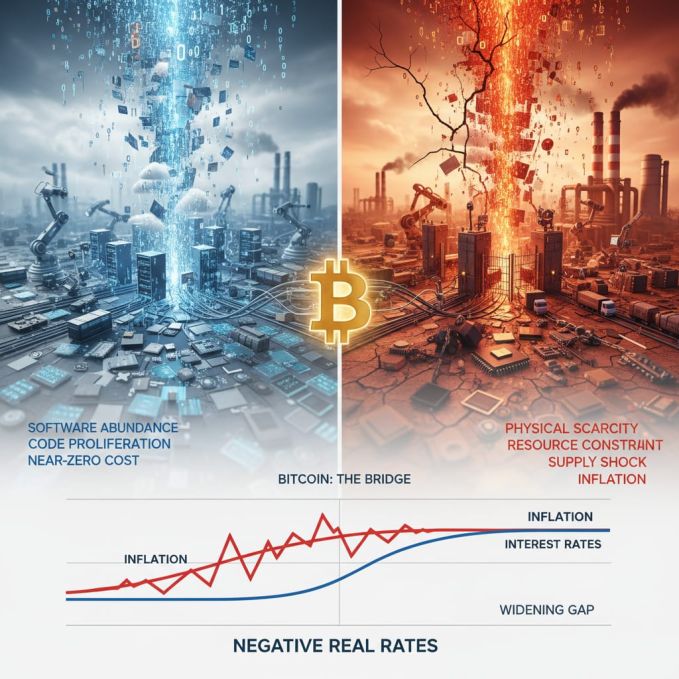
Bitcoin isn't just decoupling from software. It's transitioning from being a risk asset to becoming the premier scarcity play in a world bifurcating between digital deflation and physical inflation.
This insight comes from Jordi Visser, a portfolio manager who has spent years watching the infrastructure buildout for AI and its cascading consequences. What he's uncovered is a regime change so fundamental it's rewriting the playbook for where value gets created.
The Margin Compression Thesis: "Your Margin Is My Opportunity"
Begin with the software story, because it sets the stage for everything else.
AI is commoditizing code.
Bezos said it best: "Your margin is my opportunity." When margins exist in code-based businesses — software, SaaS, cloud services — someone will undercut them. And right now, that someone is AI.
Enterprise software companies are facing a brutal reality. The productivity gains they're promising with AI integration aren't materializing. At least, not at the scale they need. The integration is harder than expected. The organizational friction is real. The gains are incremental, not transformational.
Meanwhile, AI itself is becoming free at the margin. GPT-4 costs pennies per million tokens. Open-source models run on consumer hardware. The competitive moat of proprietary code is evaporating.
Result: Software company margins are in "freefall," as Visser bluntly puts it.
This explains why enterprise software stocks — ServiceNow, Salesforce, Workday — are struggling despite their AI narratives. Management is spinning AI as transformational. The market is pricing in disappointment.
The Flip Side: Bitcoin Benefits Because It Has No Margins to Compress
Here's the elegant insight: "Bitcoin benefits because it doesn't get hurt by that."
Bitcoin isn't trying to deliver software margins. It's not promising productivity gains from AI integration. It's doing something simpler and more powerful: it's a fixed-supply store of value in an inflationary environment.
The conversation is shifting. Bitcoin is no longer just a risk asset that correlates with tech stocks. It's moving into the "scarcity bucket" alongside physical commodities — the same bucket where real assets outperform in inflationary regimes.
And that shift is accelerating because of something much bigger than software commoditization.
The Bottleneck Cascade: From Chips to Chemicals
Here's the thesis that drives everything: we're entering a commodity supercycle driven by AI infrastructure buildout, and it's creating bottlenecks that cascade across the entire physical economy.
Four months ago, the bottleneck was memory. Chips for AI training required specific memory configurations, and supply was tight.
Then the conversation shifted. "We started to shift toward AI agents. Everything shifted to inference."
Inference — running trained models to generate outputs — has completely different infrastructure requirements. You don't need massive GPU clusters for pre-training. You need memory, networking, and packaging. Lots of it.
Suddenly the bottleneck spread from memory to CPUs to packaging to chemicals.
Why chemicals? Because the fiber optic cables that connect data centers, the chemical processes for semiconductor packaging, the rare materials embedded in advanced chips — all of that infrastructure requires chemical inputs. And chemical supply is constrained.
Then you add geopolitical risk. Iran tensions. Trade restrictions. Supply chain vulnerabilities. And the bottleneck accelerates.
The result: "We are in a commodity bull market. We have shortages across the globe."
The Negative Real Rates Setup: The Perfect Environment for Scarce Assets
Now comes the macro setup that ties this all together.
Deflationary forces — AI disruption, software commoditization, productivity gains — are keeping the Fed from hiking aggressively. The Fed sees demand destruction coming in certain sectors and stays cautious.
But physical bottlenecks are driving headline inflation. CPI will go above 4%.
Meanwhile, the Fed keeps 3-month bill rates below 4%.
Negative real yields.
This is the environment where scarce assets — Bitcoin, gold, real estate, commodities — dramatically outperform financial assets. This is the 1970s playbook updated for the AI era.
"Three-month bills will stay below 4% and we'll have negative real yields. CPI will be above 4%."
This isn't a prediction. It's a mathematical consequence of the current policy setup colliding with the physical constraints of the real world.
The Picks and Shovels Play: Infrastructure Beats Applications
There's a historical pattern embedded in infrastructure buildouts. Railroad booms. Electrification. The internet. The pattern is always the same: picks and shovels outperform end applications.
Right now, "picks and shovels" means:
- Chemical companies (for packaging, fiber optics, materials)
- Semiconductor packaging companies
- Server and rack manufacturers (Dell, HPE, Super Micro)
- Bitcoin miners (who have compute infrastructure)
- Power companies (electricity is the constraint)
Meanwhile, the end applications — AI software companies, enterprise AI platforms, companies promising transformational productivity — are facing headwinds. Enterprise AI adoption is harder than expected. The benefits aren't materializing at scale. The integration friction is real.
"Big companies are not going to see the benefit come through the way they think because it is just so hard."
This is the bet: physical infrastructure players will outperform software application players by a significant margin over the next 12–18 months.
Bitcoin Miners: An Overlooked Leverage Play
One specific insight worth emphasizing: Bitcoin miners have become a leveraged play on compute scarcity.
They're no longer just mining Bitcoin for its own sake. They're renting compute capacity to AI companies that need inference compute. They're hosting data centers. They're becoming infrastructure providers.
This transforms the profitability equation. Bitcoin miners move from a pure commodity play (mine BTC, sell it) to a margin play (mine BTC + rent compute at premium margins).
The stocks have already started moving on this realization. But the mainstream investment world hasn't caught up yet.
The Enterprise AI Disappointment Coming
Expect to hear this phrase repeatedly in earnings calls: "Enterprise AI adoption is slower than we thought."
IBM reported, ServiceNow reported, and the market reacted negatively. Management wasn't addressing the fundamental question: can enterprises actually integrate and benefit from AI at scale, or is this another ERP disappointment?
Visser's thesis is that large enterprises will struggle. Legacy systems, organizational inertia, change management complexity — it's all harder than the hype suggests.
Meanwhile, pure-play AI infrastructure companies and startups — companies without the organizational friction — are winning. They can move faster. They can iterate. They can deploy.
Earnings season will confirm that split.
The Asset Allocation Shift
If you accept this thesis, the positioning becomes clear:
Reduce: Enterprise software — especially high-multiple SaaS companies with vague AI narratives.
Increase:
- Chemical stocks (for the supply chain arbitrage)
- Semiconductor packaging companies
- Server and infrastructure players
- Bitcoin (from 1–5% to 20–30% of portfolio, depending on risk tolerance)
- Bitcoin miners
- Power and energy companies
Monitor: Enterprise software earnings for the moment when AI disappointment becomes consensus.
The trade in one line: Scarcity beats abundance. Physical beats digital. Infrastructure beats applications.
Why This Matters
The easy interpretation of the current market: tech is struggling, Bitcoin is doing okay, everything else is boring.
The sophisticated interpretation: we're in the early innings of a fundamental regime change where physical assets with supply constraints outperform digital assets with marginal costs approaching zero.
The difference between these two interpretations is billions of dollars in opportunity.
Bitcoin transitioning from a risk asset into a scarcity asset isn't just an interesting market observation. It's a signal that the entire risk landscape is reshaping. When negative real rates materialize — and they will — scarce assets will move in ways that surprise most investors. Bitcoin will look cheap in hindsight.
The time to position for that regime change is before consensus catches up.
PTL Signal: Listen to the full conversation between Jordi Visser and Anthony Pompliano. The granularity on the bottleneck cascade — from chips to chemicals — and the specific miner thesis is worth the time.
Lisa Tamati covers Bitcoin, markets, AI, and exponential technology at PTLsignal.com. This analysis is for informational purposes only and does not constitute investment advice.
// newsletter
Want more like this?
Join the PTL Signal newsletter. Weekly AI, Bitcoin & market analysis from Lisa Tamati.