Tesla's Distributed Brain: Why FSD 14.3 Is Just the Beginning of a Planetary-Scale AI Network
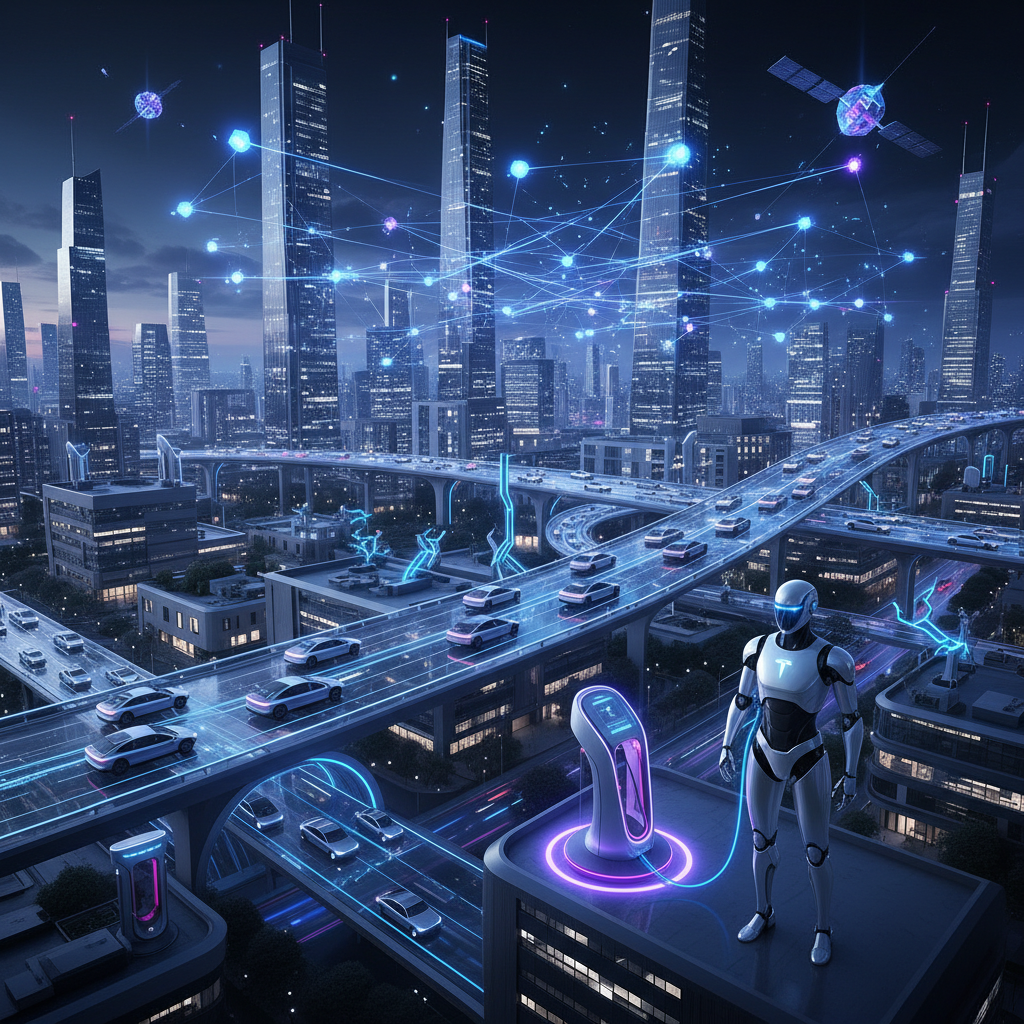
Analysis of a deep-dive conversation with Tesla expert Cern Basher and Phil on Tesla's AI breakthroughs and distributed computing vision.
The Imminent Robotaxi Revolution
For anyone tracking the bleeding edge of artificial intelligence and its impact on markets, a recent deep-dive conversation involving Tesla analyst Cern Basher and co-host Phil offered an unparalleled look at what's unfolding inside Elon Musk's ecosystem. The primary takeaway: Tesla is on the precipice of unsupervised robotaxi deployment, driven by breakthroughs that are far more fundamental than iterative software updates.
FSD 14.3, Tesla's latest Full Self-Driving release, isn't just another step. According to Basher and Phil, it represents a major milestone fuelled by two critical advancements: a ground-up rewrite of Tesla's AI compiler and extensive reinforcement learning data gathered from real-world robotaxi testing in places like Austin.
As Phil noted, the previous hardware (Hardware 3) "may end up with a reasonable supervised FSD, but will never go unsupervised." This highlights a critical inflection point — the current FSD 14.3, running on Hardware 4 and above, is fundamentally different. "I think we're very very close," Phil asserted. "I see all the things lining up that makes it feel like it's very very close." This isn't tech fan optimism; it's an analysis pointing to a convergence of capabilities.
The Distributed Intelligence Network: Tesla's Persistent Computer
Beyond FSD, the conversation unveiled Tesla's audacious vision of a distributed intelligence network that reimagines the very architecture of computing. This isn't merely about self-driving cars; it's about building a "persistent computer" fabric that extends beyond vehicles into homes, Superchargers, upcoming Optimus robots, and even space.
Phil eloquently explained how Musk's various ventures intertwine: "Really, Starlink is just a conduit, the intelligence cloud, the AI data center that Tesla will build." Starlink isn't just for internet access — it's the backbone for a global, low-latency, distributed AI network.
This grand vision suggests that what we're witnessing is the construction of a planetary-scale supercomputer, with every Tesla vehicle, every Supercharger, and eventually every Optimus robot contributing to a shared, constantly learning intelligence. "We're starting to see the inseparability between Tesla and SpaceX," Phil observed, underscoring how interdependent these projects have become in realising this distributed AI dream.
The AI Compiler Revolution and Hardware Optimisation
The technical backbone enabling this leap is Tesla's complete rewrite of their AI compiler. Utilising MLIR (Multi-Level Intermediate Representation), this is not a minor tweak but a foundational architectural shift. This compiler rewrite yielded a 20% faster reaction time for FSD 14.3 and significantly improved model iteration speed.
As explained in the conversation, "this was the big optimization... this was the step where they said let's take a step back, let's spend the time and let's do it right." Such a comprehensive overhaul demonstrates Tesla's commitment to optimising its neural network inference capabilities across diverse hardware generations.
This deep optimisation indicates a relentless pursuit of efficiency and performance, ensuring that Tesla's hardware — from FSD chips to Dojo supercomputers — can extract maximum value from its constantly evolving AI models. For investors, this horizontal integration from custom silicon to compiler represents a significant moat against competitors.
Intelligence as a Commodity and Market Creation
The most profound conceptual shift discussed was the commodification of intelligence. Basher and Phil explored how AI is transforming intelligence from an abstract human cognitive function into a quantifiable, routable, and arbitrageable resource.
"Intelligence is going to become a type of commodity," Phil suggested. This means AI power can be traded, priced, and deployed dynamically across Tesla's vast network. Imagine a marketplace where computing cycles from your parked Tesla could be leveraged by a robotaxi across the city, or contribute to a larger AI training task.
This distributed intelligence network acts like an "AI router," directing intelligence where it's needed most, enabling unprecedented efficiencies and the creation of entirely new markets. The conversation posited that this could fundamentally alter economic models, much like the internet commodified information access.
Optimus Evolution and Manufacturing Strategy
The discussion also touched on the highly anticipated Optimus V3 robot. Tesla's strategy for Optimus, reminiscent of Apple's secretive development of the iPhone, suggests a deliberate approach to balancing capability, manufacturability, and strategic market entry.
Phil's rhetorical question — "Did Apple preview the iPhone before they showed it off to the world?" — underscored Tesla's tendency for dramatic, impactful reveals rather than incremental teasers. The implications are enormous. Optimus isn't just a lab project; it's designed for mass production and deployment across various domains, from factories to homes and even space exploration.
"Off earth will be faster... and that's not a joke," Phil stated, regarding manufacturing with robotics. This opens up fascinating possibilities for space-based manufacturing, leveraging the unique conditions of lunar or orbital environments to produce goods at vastly lower costs, which could then be delivered to Earth. This long-term vision positions Tesla as more than an automotive or AI company — it's an infrastructure builder for a future economy.
The Compute Continuum: Constant Intelligence
Basher and Phil painted a picture of a future where "we're bathed in compute intelligence... it's all around us and it's observing us and it's helping us." This concept of ambient, ubiquitous intelligence is the natural progression of Tesla's distributed network.
Every device, every sensor, every vehicle becomes a node in a constantly learning, constantly evolving AI. This moves beyond traditional cloud computing to a truly pervasive intelligence that anticipates needs and offers assistance seamlessly. For investors and technologists, this shift from centralised data centres to a distributed, ambient intelligence represents a paradigm change in how computing power will be accessed and utilised.
The Investment Thesis: Infrastructure for the Future Economy
For PTL Signal readers, the implications are clear: Tesla is building not just cars, but the foundational AI and robotics infrastructure for the next global economy.
This isn't merely about selling more cars or even robotaxis. It's about creating a vertically integrated, intelligent ecosystem that will generate new revenue streams from:
- Robotaxi Fleet Operation: A high-margin autonomous transportation service.
- AI-as-a-Service: Licensing intelligence, compute, or simulation capabilities.
- Robot Deployment: From factories to homes, Optimus robots will address labour shortages and automate tasks.
- Distributed Energy & Compute: Leveraging Supercharger networks and Starlink for a global AI backbone.
- Space-based Manufacturing & Logistics: An ambitious long-term play on a new industrial revolution.
As Phil put it, "Elon isn't propping up a million satellites in space for its health. That is a money-making exercise at some point" — emphasising the commercial imperative behind even the most ambitious projects.
Tesla's integrated approach — from custom silicon and AI compiler optimisation to a distributed physical and digital intelligence network — creates a formidable moat. The deep technical discussions highlight that this isn't just vision, but execution at a level few companies can match.
Lisa Tamati covers the intersection of technology, AI, and markets at PTLsignal.com. This analysis is for informational purposes only and does not constitute investment advice.
Follow Cern Basher's insights on Tesla and AI on X at @CernBasher.
// newsletter
Want more like this?
Join the PTL Signal newsletter. Weekly AI, Bitcoin & market analysis from Lisa Tamati.