The AI Disruption Trade: Why Jordi Visser Says Bitcoin Is the Only Scarcity Left
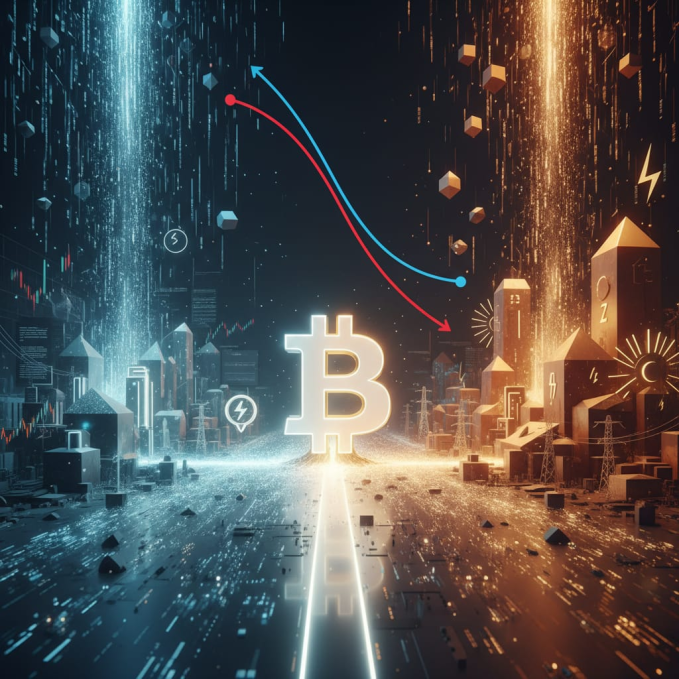
Reporting on a conversation with Bankless about moat destruction, commodity inflation, and the endgame of fiat.
The Setup: AI Destroys Everything Except Bitcoin
In a recent conversation with the Bankless Podcast team, macro strategist Jordi Visser laid out a thesis that's as contrarian as it is compelling: AI systematically destroys the moats of every asset except one — Bitcoin.
The logic is deceptively simple. AI commoditizes knowledge work. It destroys software. It erodes any competitive advantage based on code, processing, or human intelligence. Meanwhile, the physical infrastructure required to run AI at scale creates bottlenecks that drive commodity inflation. This creates the rare regime where everything code-based gets cheaper while everything physical gets more expensive.
The result: negative real rates (inflation exceeding interest rates), which historically delivers 247% annualized returns for Bitcoin.
This isn't a crypto bull making noise. This is a serious macro call about how AI is reshaping asset values across the economy.
The Bifurcation: Software Apocalypse, Commodity Surge
Visser's thesis splits the world into two.
On one side: Massive deflation in software and knowledge-based businesses. Every SaaS company, every code-based business, every service that can be automated — facing terminal value destruction as AI advances.
The evidence is already visible. When new AI models release, SaaS stocks sell off. The market is pricing in the reality that code moats are disappearing.
"Every single thing that people own as a store of value gets disrupted by AI," Visser argued. "If three years from now AI is moving so fast that you can create software with your mouth, these companies lose value in the future."
This is why the trade is short software, long physical infrastructure.
On the other side: The physical buildout required to run AI infrastructure creates genuine commodity inflation.
Energy, copper, silver, semiconductors, memory — all constrained inputs for the AI boom. Electricity prices are already rising. Copper is tight. Semiconductors are bottlenecked. "Every single thing that is in your apartment, every single thing that you use on a daily basis now that involves technology has semiconductors in it," Visser noted.
This bifurcation is the key. AI creates a deflationary force (knowledge, code, services) and an inflationary force (physical resources) simultaneously.
The Macro Signal: Approaching Negative Real Rates
Here's where it gets interesting for investors.
The Fed Funds rate is currently 4.25–4.5%. CPI is at 3.3% and rising, expected to hit 3.6%+ as physical constraints manifest. The Fed can't raise rates further because the labour market is weakening — unemployment is creeping up.
This is the setup for negative real rates: inflation exceeding the Fed's ability to maintain restrictive policy.
Historically, this regime has been Bitcoin's playground. The data shows 247% annualized returns for Bitcoin during negative real rate periods. This is when investors flee from fiat, from depreciating cash, from financial assets, into the only truly scarce store of value.
The macro signal is HIGH CONVICTION: negative real rates are approaching. The catalyst is either rising inflation from physical bottlenecks (supply-side) or falling rates from Fed capitulation (demand-side). Either way, the regime is coming.
The Radical Call: S&P 500 Flat for a Decade Despite 2x Economic Growth
Visser made a provocative prediction: The economy will double over the next 10 years, but the S&P 500 will be flat.
How is this possible? Multiple compression. As AI destroys corporate moats, value transfers away from large public companies to agile entrepreneurs and decentralized builders who can adapt quickly. The concentration in Mag-7 unwinds. Dispersion increases.
"Right now the S&P 500 market cap is more than two times the size of the economy, a record going back all the way to the Great Depression," Visser noted. Historical precedent suggests this excess valuation compresses significantly.
The implication: avoid broad market exposure and instead focus on specific beneficiaries of AI infrastructure or individual-entrepreneur-driven opportunities.
This is a direct challenge to the "stocks go up forever" thesis. If correct, it means 2026–2036 is a period of value rotation, not broad market expansion.
Bitcoin's Unique Position: Scarce in a World of Abundance
This is where Visser's case for Bitcoin crystallizes.
While AI creates abundance in everything code-based, Bitcoin remains the only asset whose scarcity is guaranteed by physics and mathematics, not by market conditions or management decisions. 21 million coins. That's it. No amount of AI changes that.
"Bitcoin gets treated less like abundance and more like scarcity, and I believe that time is coming soon," Visser argued. "Bitcoin is the purest form of the AI trade."
In a regime where:
- Software moats are destroyed (deflation)
- Physical infrastructure is bottlenecked (inflation)
- Real rates go negative
- Capital flees depreciating fiat
Bitcoin is the only truly scarce asset that captures value across both the deflationary and inflationary regimes.
The Trade Signals for Investors
Based on Visser's macro framework, here are the key trading implications:
Bullish Bitcoin signals:
- Catalyst: Approaching negative real rate regime (CPI >3.6%, Fed Funds cannot rise above 4.5% due to weak employment)
- Conviction: HIGH
- Trade: Long Bitcoin via spot, MSTR calls, or Bitcoin call spreads (e.g., buy MSTR $350 calls, sell $450 calls for 3-month defined-risk exposure)
- Entry: Reaccumulation on CPI weakness before consensus shifts to negative real rates
Bearish software signals:
- Thesis: Terminal value destruction as AI commoditizes code
- Evidence: SaaS selloffs on new AI model releases
- Trade: Short software exposure, avoid Mag-7 concentration
- Specific: Consider put spreads on CRM, SNOW, TEAM (benefit from continued weakness without unlimited downside)
Bullish physical infrastructure signals:
- Thesis: Commodity inflation from AI infrastructure buildout
- Beneficiaries: Energy, copper, silver, semiconductors
- Trade: Long materials, short duration bonds
Cautionary on S&P 500:
- Thesis: Flat returns for 10 years despite 2x economic growth (multiple compression as AI destroys moats)
- Implication: Avoid passive broad market exposure, rotate to specific beneficiaries
The Quantum Computing Overhang (Minimal Risk)
One question always surfaces: doesn't quantum computing pose an existential risk to Bitcoin?
Visser addressed this directly. While quantum computing is a long-term concern, it's dramatically overstated relative to immediate threats. Bitcoin can be upgraded to quantum-resistant cryptography. The real risks Bitcoin faces today are regulatory, not computational.
"There are three memes in the world that have been decided by people that have survived the test of time: gold, religion, and now Bitcoin," Visser observed. This isn't to say quantum is no risk, but it's not the pressing concern.
What This Means for Your Portfolio
If Visser is right — and the macro setup certainly suggests the negative real rate regime is approaching — then:
- Bitcoin exposure increases in relevance as the only truly scarce asset in an abundance-driven AI world
- Software and knowledge-work concentration should be reduced, as AI moats erode
- Physical infrastructure exposure should increase, as bottlenecks drive commodity inflation
- Broad market exposure faces headwinds, as multiple compression offsets economic growth
- Negative real rates become the dominant macro regime, rewarding scarcity over productivity
This isn't a call to go all-in on Bitcoin or abandon equity exposure entirely. It's a framework for understanding how AI reshapes asset values over the next decade.
The question investors should be asking: In a world where code gets cheaper and physical resources get scarcer, which assets preserve value?
Visser's answer is clear. Bitcoin.
Listen to the full conversation between Jordi Visser and Bankless for deeper exploration of these macro themes.
Lisa Tamati reports on Bitcoin, macro economics, and technology at PTLsignal.com. This analysis is for informational purposes only and does not constitute investment advice.
// newsletter
Want more like this?
Join the PTL Signal newsletter. Weekly AI, Bitcoin & market analysis from Lisa Tamati.