The Dozen Doublings: Why Salim Ismail Says We're Choosing Between Star Trek and Mad Max
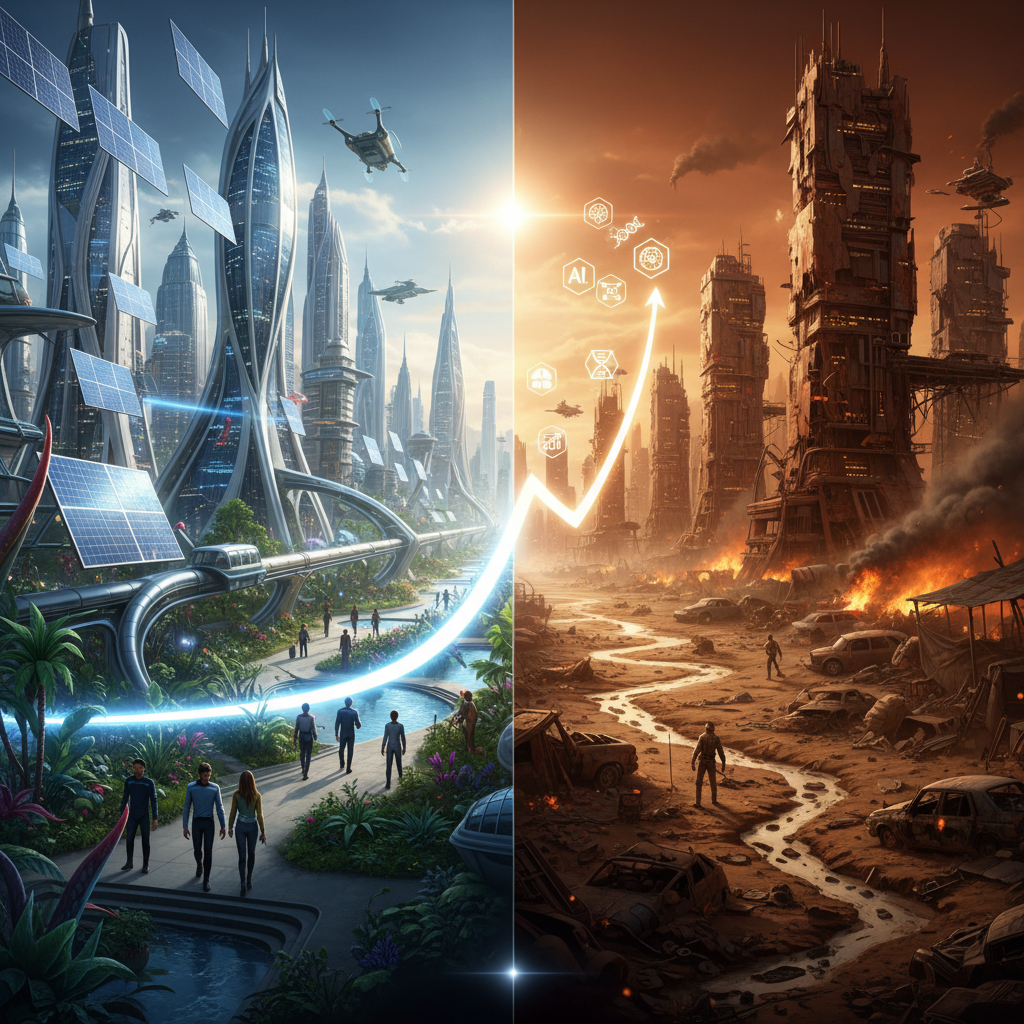
Analysis of a conversation between Salim Ismail, founding executive director of Singularity University, and Geoff Neilson.
When Moore's Law Becomes Everything
In a recent conversation with Geoff Neilson, Salim Ismail — the founding executive director of Singularity University and author of Exponential Organizations — laid out a framework that reframes how we should understand technological change. Ismail isn't just talking about AI disruption. He's describing something unprecedented in human history: a dozen technologies simultaneously doubling in capability while costs plummet toward zero.
Here's the math that matters: AI capabilities are doubling every 8–10 weeks. Drones every 9 months. Solar energy every 22 months. Neuroscience imaging yearly. We've seen Moore's Law drive computational progress for decades. What's different now, according to Ismail, is that computation has "seeped into a bunch of other fields" — creating synchronized exponential growth across the entire technological stack.
"Today, for the first time in human history, advanced technologies are cheap," Ismail emphasized. "Whether you spend 20 bucks a month or a million bucks on AI, you're getting basically the same thing."
This isn't incremental improvement. It's a phase change. And it forces a civilizational choice that Ismail frames starkly: Star Trek or Mad Max. Abundance or collapse. As he observed, we're currently doing both at the same time.
The Dozen Doublings
Let's walk through what's actually doubling and on what timeline:
Artificial Intelligence: Doubling every 8–10 weeks in capability. Not just model size — reasoning, code generation, multimodal understanding. The pace is accelerating beyond what OpenAI or Anthropic publicly acknowledge.
Drones: Capability doubling every 9 months. Autonomy, battery life, payload capacity. The gap between military and civilian applications is collapsing.
Solar Energy: Cost-performance doubling every 22 months. We're approaching 1¢ per kilowatt-hour — below the cost of transmission. Energy becomes essentially free at the margin.
Neuroscience Imaging: Resolution and capability doubling yearly. We're mapping neural circuits at scale, approaching the ability to read and potentially write brain states.
CRISPR and Gene Editing: Cost and precision improving on similar curves. Biology becoming programmable.
Robotics: Actuation, sensing, and mobility all converging. The hardware bottleneck that kept robots in factories is disappearing.
3D Printing: Speed, precision, and material range expanding. Manufacturing at the edge becomes viable.
Quantum Computing: Still early, but qubit counts and coherence times improving exponentially. Cryptography and simulation applications approaching practicality.
Materials Science: Graphene, metamaterials, and novel compounds emerging from AI-designed molecular structures.
Blockchain and Decentralized Systems: Throughput and usability improving despite market volatility. Coordination mechanisms without centralized authority becoming viable.
Virtual and Augmented Reality: Resolution, field of view, and comfort all advancing. The interface between digital and physical blurring.
Synthetic Biology: Organisms engineered for specific purposes — carbon capture, material production, medicine synthesis.
Each of these individually would reshape industries. Combined, they reshape civilization. And they're not just advancing — they're converging, amplifying each other's impact in ways that create emergent capabilities no one technology could achieve alone.
From Scarcity to Abundance
For 10,000 years, human civilization has operated on scarcity. Food, water, energy, shelter — all limited, all requiring trade-offs, all generating conflict. Ismail argues we're approaching the end of that era.
"So we've run the world on scarcity for the whole of history of humanity," he noted.
The abundance cascade works like this: Solar at 1¢/kWh makes energy essentially free. Free energy makes desalination economically viable at scale. Free water eliminates half of global infectious disease burden. Free water and energy make vertical agriculture profitable. Cheap food reduces conflict over agricultural land. Abundant resources reduce the zero-sum competition that has driven most of human history.
This isn't utopian thinking. It's thermodynamic. Once the energy input becomes negligible, the entire cost structure of physical goods collapses.
But abundance breaks institutions. Journalism, education, democracy, legal systems — they all evolved to allocate scarce resources, mediate conflicts over scarcity, and organise production under constraint. Remove the scarcity and the institutions lose their reason for being.
"This is a huge challenge for all the institutions by which we run the world," Ismail warned. "They're all dissolving in front of us. Journalism is broken. Education is broken. Democracy is breaking in front of our eyes."
Institutional Collapse and Renewal
Ismail's institutional analysis is particularly relevant for investors and builders. The organisations that dominate today's landscape — universities, media conglomerates, nation-states, legacy corporations — optimised for a scarcity world that is disappearing.
Their immune systems, designed to protect against change, now prevent adaptation. Universities clinging to credentialing monopoly as knowledge becomes free. Media companies protecting distribution control as attention fragments. Nation-states asserting territorial sovereignty as digital identity transcends geography.
"I think the future of the world is going to be city states rather than nation states," Ismail predicted. The logic is straightforward: city-states can adapt faster, experiment more aggressively, and attract talent globally without the baggage of national identity politics.
Singapore and Dubai as models — not perfect, but responsive in ways that Washington or Brussels cannot be.
For entrepreneurs, this creates opportunity in institutional voids. Build the new universities (Lambda School, On Deck). Build the new media (Substack, podcasts). Build the new governance mechanisms (DAOs, network states). The old institutions won't reform fast enough. They'll be replaced.
The Future of Work
Perhaps the most practical section of Ismail's analysis concerns employment. The knowledge work that employed hundreds of millions is being automated faster than new categories emerge.
"I think we'll be able to run a typical company with about 20 to 30% of the workforce that we had before," Ismail projected. The math is simple: AI handles research, analysis, writing, coding, design, customer service. Humans focus on strategy, relationships, and tasks AI cannot yet do.
But this doesn't mean mass unemployment. It means workforce transformation. Ismail expects "five times more companies" as the barrier to entrepreneurship collapses. A 5–10 person team with AI assistance can build what previously required 100 people and millions in funding.
"I think we'll end up with companies in the 5 to 10 person range building billion dollar companies, and they're going to do it very quickly."
The job description of the future isn't employee. It's entrepreneur.
"The only real job description of the future is going to be entrepreneur."
This sounds terrifying to anyone with a stable job. But Ismail frames it differently: purpose-driven work rather than process-driven work. Humans doing what humans do uniquely — vision, connection, meaning-making — while AI handles execution.
Star Trek or Mad Max
Ismail ended with a framing that captures the moment: "We've got two futures in front of us: a Star Trek future and a Mad Max future... I thought we'd be one or the other, but it seems, per all the science fiction novels, we're doing both at the same time."
Some regions, some populations, will experience the abundance transition — free energy, free water, disease elimination, material plenty. Others will experience institutional collapse — failed states, resource conflict, technological displacement without safety nets.
The Star Trek future requires: proactive institutional redesign, aggressive wealth redistribution during the transition, global coordination on existential risks (AI alignment, biosecurity, climate).
The Mad Max future results from: institutional resistance to change, winner-take-all capture of abundance gains, failure to manage transition costs for displaced populations.
We're currently tracking both simultaneously. California and Singapore building abundance infrastructure while failed states collapse. Tech billionaires funding longevity research while life expectancy declines in the American heartland.
The Cognitive Challenge
Underlying everything is a cognitive mismatch Ismail quoted E.O. Wilson to capture: "The problem with humanity is our emotions are Paleolithic, our institutions are medieval and our technology is godlike."
We evolved to respond to immediate threats (the amygdala), built institutions for agricultural and industrial eras, and now wield powers that remake planets. Our brains don't naturally understand exponential curves. We linearise, underestimate, and respond too late.
"Our brains cognitively do not understand this pattern," Ismail observed. "We're ten times more likely to pay attention to the negative news than positive news because of that old survival factor."
This creates the final challenge: recognising that abundance is possible even while acknowledging that collapse is probable without deliberate intervention. Optimism and vigilance simultaneously. Not naive techno-utopianism. Not fatalistic doom. Active shaping of transition.
What This Means
Ismail's framework explains why the current moment feels so disorienting. It's not just that things are changing fast. It's that multiple fundamental assumptions — about work, scarcity, institutions, national identity — are becoming obsolete simultaneously.
The investment implications are profound. Traditional diversification assumes stable institutions and gradual change. Ismail's framework suggests concentrated bets on: (1) the infrastructure of abundance (solar, AI compute, desalination), (2) the platforms enabling small-team entrepreneurship, (3) the jurisdictions adapting fastest to institutional redesign (city-states, special economic zones).
The personal implications are equally significant. The stable career path, the institutional credential, the geographic stability — all scarcity-era assumptions. The future belongs to adaptive generalists, rapid learners, and those comfortable with uncertainty.
Ismail ended with what amounts to both warning and invitation: "There's only two modalities of companies in the future. You're either the disruptor or you are disrupted. There's no middle ground."
The same applies to individuals, institutions, and nations. The exponential curve doesn't care about preferences. It only cares whether you're riding it or being crushed by it.
Lisa Tamati covers technology, macro, and the future of civilisation at PTLsignal.com. This analysis is for informational purposes only and does not constitute investment advice.
Follow Salim Ismail at Exponential Organizations and on X.
// newsletter
Want more like this?
Join the PTL Signal newsletter. Weekly AI, Bitcoin & market analysis from Lisa Tamati.